



Guest Blogger, Ed Gawlinski, has been involved in many cultural organizations throughout his life. Here, he discusses Easter traditions in several Eastern European cultures.
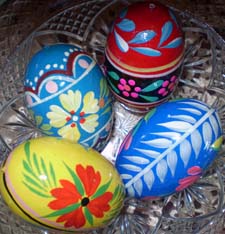
A common custom is to color hard boiled eggs for Easter. We usually colored them on Good Friday, while eating hot cross buns…
Hot cross buns,
one ha’ penny,
two ha’ penny,
hot cross buns.
If you have no daughters,
give them to your sons,
one ha’ penny,
two ha’ penny,
Hot Cross Buns
In Eastern Europe (Poland, Ukraine, Czech, Slovakia, Slovenia, Serbia, Croatia, Russia, Bulgaria, etc.) coloring Easter eggs is a highly developed folk art. In the Polish language there are several different words for colored Easter eggs, each indicating a different technique. The style I know best is called Pisanki. In this you use a stylus to draw on the egg with melted wax. After you draw, you put the egg in the dye. After it dries, you draw some more and then put the egg in a different colored dye. The wax keeps that part of the egg from being dyed. It’s a process similar to batik. Intricate and beautiful patterns are made by skilled artists. I am not a skilled artist, so my eggs were never works of art. But I did have fun trying.
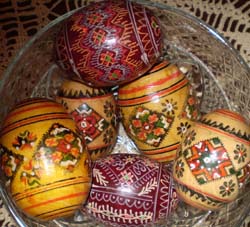
Another style is called Kraszanki. We had an exchange student from Switzerland whose family colored eggs this way. They put onion peels in the water they used to boil the eggs. The eggs came out brown. You could use oak bark or walnut shells to make the eggs black. You could use Marigold flowers to make the eggs yellow.
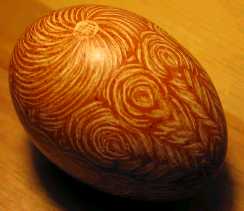
The opposite approach to pisanki is drapanki. These eggs are first died and then, using a sharp tool, you scratch off the dye to make your designs.
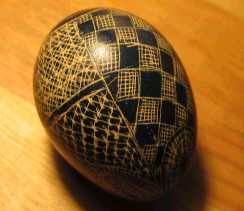
Although elaborately decorated eggs are part of the tradition of all Eastern European countries, each one has its own tradition as far as the patterns used to decorate these eggs.
This article was posted on Wednesday, February 20th, 2008 at 3:30 pm and is filed under Bulgaria, Countries & Cultures, Croatia, Customs and Traditions, Czech Republic, Easter, Easter Eggs, England, English Nursery Rhymes, Good Friday, Good Friday Songs, Holiday Songs, Holidays Around the World, Hot Cross Buns, Mama Lisa, Nursery Rhymes, Poland, Russia, Serbia, Slovakia, Slovenia, Ukraine, United Kingdom. You can follow any responses to this entry through the RSS 2.0 feed. You can skip to the end and leave a response. Pinging is currently not allowed.


March 30th, 2009 at 5:30 pm
Hello,
I am leanring to decorate Easter eggs in the traditional Romanian manner, which I believe is the same as for the Ukrainian pysanky except that Romanians tend to use geometric shapes. Have you run across any books that you can recommend about Romanian Easter egg decorating? It’s ok if the book is in Romanian as long as it has lots of diagrams and photos. A step-by-step guide for specific designs would be wonderful.
Thank you.
Sincerely,
Judy Mathison, Waukesha, WI
October 29th, 2010 at 12:41 pm
Cool ideas here, thanks. I actually took the plunge and got me some chickens last week! Now I have so many eggs like you wouldn’t believe. You might be interested in these egg recipes.
March 6th, 2011 at 5:40 am
Awake, thou wintry earth – Fling off thy sadness! Fair vernal flowers, laugh forth Your ancient gladness! Thomas Blackburn An Easter Hymn.