



I love reading about day-to-day life in the olden days! It’s fascinating how it was so different from the modern world.
Project Gutenberg just posted a book to read online or download called Domestic Life in Virginia in the 17th Century. Presumably, it would be similar throughout the North American colonies at that point in time.
Here’s a part I found to be interesting about how they cooked and washed clothes (they didn’t do laundry too often – so they wore a lot of perfume!)…
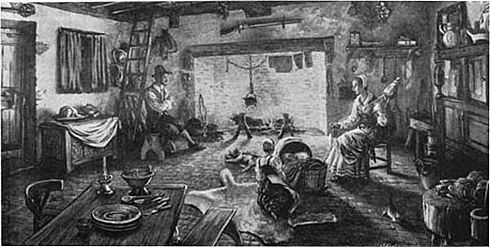
In the summer months, much of the cooking was done out-of-doors in huge pots slung from a tripod. The food for the servants went into a single pot, and their fare in “pap” was eaten in the open also, when the weather permitted. In the winter and during the cooler months, cooking was done on the hearth of an ample fireplace which customarily took up the greater part of the end of a room. If the family was of modest means, the kitchen area was the heart of the house. Here, in winter, was warmth, food and companionship. As the planter acquired numerous servants and preparation of food became an all-day matter, every day, the kitchen with its companion room, the buttery, was divorced from the house. Under this arrangement, the mistress of the household merely directed the preparation of food, the care of the dairy products, the salting of the meat, and the rendering of the lard.
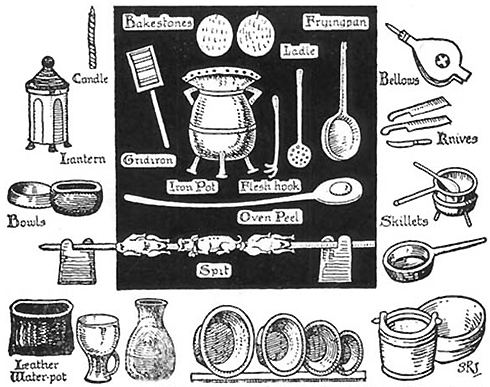
Before the fire on the great hearth, meat on joints and fowl were trussed on spits, and to some small boy fell the task of keeping the spit turning. A drip-pan placed beneath caught the juices. Bakestones, griddles and clay ovens were at hand to stand on the hot embers, and later, ovens were built into the fireplaces. From cranes, simple at first and later with convenient arrangements for tipping, hung the pots for boiling. Bellows were at hand to enliven dying embers. On a rough table stood the brass mortar and iron pestle for mixing, the flesh-hook for handling meats, brass skimmer, rolling-pin, and other handy cooking utensils. Besides, in an adjoining space, there were pans, butter-pots, tubs and trays for the milk and milk products.
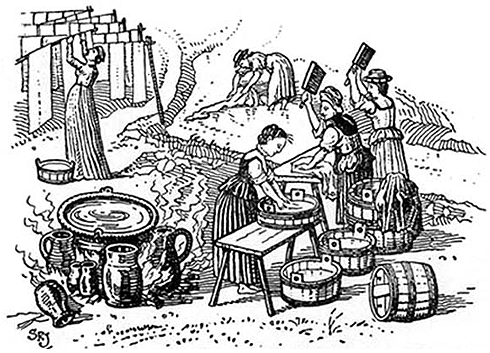
Water, which had to be drawn by hand from wells, except for an occasional windmill, was not a plentiful commodity. Therefore, the washing of clothes was not the semi-weekly operation carried on today with labor-saving devices. For the most part, it was carried on out-of-doors in clear weather, either at a nearby stream, or in the huge pots or tubs possessed by every family. Soap was brought into the Colony, and also was compounded from the animal fats available and the soap-ashes, which were plentiful. After soaking, the clothes were laid on boards and the grime driven out with “beetles” or paddles; then, the garments were hung up or laid out to dry or bleach in the sun. The few housewives, who owned napkin-presses, had the table-linen carefully folded, and placed, when damp, in the press in a pile. The board, screwed down firmly, eliminated the wrinkles, and the linen in some hours was smooth and ready for use. Also, various smoothing-irons and goffering (crimping)-irons, heated on the hearth were applied to garments. In all, however, laundering was a laborious process. Perfume, therefore, was a popular item in milady’s toilet.
Pictures Courtesy of the artist, Sydney R. Jones from Old English Household Life by Jekyll and Jones, published by B. T. Batsford, Ltd., London.
UPDATE: Come read more about Washing Laundry with Ashes and Climbing Cherry Trees in the Good Old Days!
This article was posted on Thursday, December 11th, 2008 at 4:37 pm and is filed under Cooking, Countries & Cultures, Customs and Traditions, Food & Nutrition, Mama Lisa, People, USA. You can follow any responses to this entry through the RSS 2.0 feed. You can skip to the end and leave a response. Pinging is currently not allowed.






















July 30th, 2010 at 3:47 am
Good post. Thanks for the Gutenberg link, much appreciated.
Regards, Le Loup.