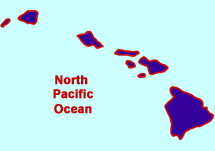


About Hawaii
It's believed that the first people to settle Hawaii arrived in canoes, from the Marquesas Islands to the south, around 300-400 AD. Later, a second group of settlers arrived from Tahiti, somewhere between 800 and 1000 AD. The Hawaiian islands remained isolated from then until 1778 when the British explorer Captain Cook discovered them. It's believed that the population at the time of Cook's arrival was 300,000. A dense agricultural society had developed, with a highly sophisticated political system.
Cook's arrival, and that of subsequent travelers thereafter, brought with them diseases from abroad. By the 1850's the Hawaiian population had been reduced to about 70,000. Those 75 years or so brought about other changes too. Christian Missionaries came to spread their religion. Businessmen and traders came to make money. The Roman alphabet was adapted for the language, making writing possible.
In 1893, the last Hawaiian leader, Queen Liliuokalani, was deposed. In 1898 Hawaii was annexed to the US. In 1900 Hawaii became a US territory and in 1959 it became a US state.
Hawaiian is a Polynesian language descended from the one brought by the original settlers from the Marquesas.
The Christian Missionaries who went to Hawaii in the 1820's to spread Christianity gave the language a written form, with 13 consonants and vowels:
The Hawaiians quickly learned to read and write. The language continued to flourish until after the last Hawaiian leader was deposed. Soon after that, Hawaiian was banned from being taught in schools. Its use declined.
In the 1970's there was a renewed interest in preserving the Hawaiian language. In 1978 Hawaiian became an official language of the state of Hawaii. Schools developed to once again teach the Hawaiian language to children.