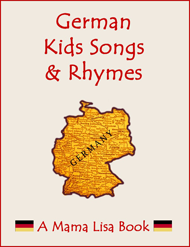
This is the German Nursery Rhymes Archive Page

Mama Lisa Facebook Badge
Mama Lisa MySpace Badge
Mama Lisa Twitter Badge
  • My Tweets

  • Blog: We Now Have 100 Languages on Mama Lisa’s World! - http://tinyurl.com/yfnm6re Visit
  • Blog: Can Anyone Help with a Czech or Slovak Kids Song? - http://tinyurl.com/ygeku5m Visit
  • Blog: Does Anyone Know a Song with the Line, “The Ship Sailed for the White Cliffs of Dover”? - http://tinyurl.com/yzb8vhm Visit
  • Blog: Can Anyone Help with a Korean Kids Song? - http://tinyurl.com/yjyklqk Visit
  • Check out Frere Jacques - Brother John a cool recording of the Song in French and English all... http://bit.ly/3O3USK Visit
  • Archive for the 'German Nursery Rhymes' Category

    Contents

    Can Someone Help with a German Lap Rhyme?

    Pennsylvania Dutch Version of Dies Ist der Daumen – This Is the Thumb

    Can Anyone Help with a Rhyme Sounding Like, “Oddly boddlee finga hoof”? It’s Most Likely German!

    Can Anyone Help with Some Swiss German Songs?

    Could Someone Please Check My English Translation of a German Nursery Rhyme?

    Can Someone Help with an Old German Nursery Rhyme?

    Can Anyone Help with a German Song/Rhyme that Begins Like “Vender kinder klinderzine”?

    Looking for a German Nursery Rhyme

    German Children’s Songs with Sheet Music and Midi Tunes

    Posts

    Can Someone Help with a German Lap Rhyme?

    Wednesday, October 28th, 2009

    Gloria wrote to me:

    Hi, my grandma (born in Eisleben in 1875, emigrating to the Midwest in 1902, married her second husband (my grandfather) in St. Paul, lived most of her life in Wisconsin with her third husband), recited a rhyme when dandling a baby on her extended foot, either with legs crossed at the hips (or just straight out, but the dad’s were best at that). The rest of the family did it for every baby/little child, including myself. We never saw it in print, and we only have the phonetic sound from listening to it. Phonetically, it went something like what follows. I would dearly love to know exactly what it meant, although it is obvious based on what happened to the child:

    Grandma (and all the rest of us who had children) would cross her legs at her hips, sit the baby on her upper ankle, hold the baby’s two hands in hers, and bounce the baby lightly up and down, until the end of the rhyme, when she would let the child fall back, laughing, and then lift the child back up, and begin again!

    Scheckle, scheckle, reiderlein,
    Ven die kinder kleinerschein
    Reiden zie auf steckerlein,

    Ven zie greis auf verten
    Reiden zie auferten
    Zen zie verten,
    Klip, Klop, Klip Klop
    Reiden zi (then something like a scary word or sounds)

    “Boom stehl leckta!” really loud!

    The adult lets the child fall back, usually grinning happily. (Sometimes a baby didn’t like it but others wanted you to pull them up onto your ankle and do it again! Some kids got a little dizzy if you did this action too fast! But mostly they loved it. I don’t remember their doing it with me, but I am certain they did, that’s where the phonetic sound and rhythm of the lines as I remember them come in, as well as my mother’s saying it to me when I was older and wanted her to tell me what it was, but it would always have been a phonetic memory, since she never really learned much German except what was common… the words you aren’t supposed to say!) This was done several times, until either one’s leg was tired, or the child needed a rest. I just used the phonetic version when I treated my kids as babies to the fun game, but for some reason I never asked my grandma. I was told that it meant something like, “When a child is little it rides on a stick horse, but when it tries to ride a real horse, he will go faster and fall off.” Have you ever heard this? I possibly have some of the phonetics wrongly remembered, but the rhythm and sounds and actions are still in my brain.

    Thanks for any help you can give. I do like your website, I found it by way of BING. I think it is very interesting as to the German, lots of Germans settled in America. My father’s ancestors may have come from Austria, as well as Germany, but came to Wisconsin in the 1840’s, met and married, learned English, so they never spoke German at all when we knew them. A grandson, age 12, who has been learning German, took to it immediately, and loves it, as well as Norwegian, so there must be an inherited acclimation to the sound of a language.

    Sincerely,

    Gloria Koeser Laundrie

    Thanks for sharing your song with us Gloria! If anyone can help with the German version and/or an English translation, please let us know in the comments below.

    Cheers!

    Mama Lisa

    Share on Facebook and other services:
    • Facebook
    • Twitter
    • MySpace
    • Digg
    • del.icio.us
    • Print this article!
    • E-mail this story to a friend!

    Pennsylvania Dutch Version of Dies Ist der Daumen – This Is the Thumb

    Saturday, October 17th, 2009

    I’ve been asked several times for the Pennsylvania Dutch Version of the German rhyme Dies Ist der Daumen – This Is the Thumb. Today I received the version below thanks to Luke and Mary Martin. Here’s what Luke wrote…

    My wife and I are also familiar with many of the German songs. This morning while looking for them, I found the finger rhyme, and your question about the Pennsylvania German variation. This is the song my father used to sing to us – seven children. Pennsylvania German has many varieties of spelling, and perhaps you can sharpen up the spelling. (My wife, Mary, and I worked at the pronunciation and spelling of the Pennsylvania German Finger Song. Mary grew up speaking Pennsylvania German.) Here it goes…

    Des ist die Daume

    Des ist die Daume
    Der schittelt die Plaume
    Der laest sie ouf
    Der traught sie Haem
    Und des glae Bopplemaul
    Bopplet alles mit’n ahnna da Haem.

    This is the thumb.
    This [one] shakes the plums,
    This [one] picks them up,
    This [one] brings them home,
    And this little tattletale tells everyone at home.

    It was always spoken, not sung.

    Thanks for your work in collecting old songs.

    Luke Martin
    (Pennsylvania)

    If anyone would like to give other variations of the spelling, feel free to in the comments below. Many thanks to Luke Martin for sending this version of the rhyme to us!

    Enjoy!

    Mama Lisa

    Share on Facebook and other services:
    • Facebook
    • Twitter
    • MySpace
    • Digg
    • del.icio.us
    • Print this article!
    • E-mail this story to a friend!

    Can Anyone Help with a Rhyme Sounding Like, “Oddly boddlee finga hoof”? It’s Most Likely German!

    Tuesday, June 9th, 2009

    David Stewart wrote:

    Lisa, maybe you can help me with a poem my mother (now 78) learned from her grandmother when she was a child. I believe it is German and she has no idea what it means but has asked many people the meaning and has never found out. Your help would be greatly appreciated. It goes something like this (of course the spelling is off):

    Oddly boddlee finga hoof
    Steck ta bow wow
    Also goot
    Katch s-mouse
    Bow wow schnauz

    If anyone can help David with the original words to this rhyme and/or a translation, please let us know in the comments below.

    Thanks!

    Mama Lisa

    Share on Facebook and other services:
    • Facebook
    • Twitter
    • MySpace
    • Digg
    • del.icio.us
    • Print this article!
    • E-mail this story to a friend!

    Can Anyone Help with Some Swiss German Songs?

    Tuesday, October 30th, 2007

    Renee wrote:

    I’m looking for three children’s songs my grandmother sung to me.

    One was: Here comes the bear, where does he want to go? He wants to go to (name of child)’s
    house. She would say this in Swiss German.

    The next was: Rumpity bumpity halter stock, vermind. She would also speak in Swiss German and I am unsure of the rest of it. The middle of the song she asked how many fingers she held up. If you were correct, the song continued, if not, she went back to the beginning. But the end was: What do you want water or wine? If you wanted water she would vigorously rub your back. If it was wine she would tell you were too young for wine and slap your behind.

    The third was a song she would sing while walking with us. She would hold both our hands and she would criss cross hers and swing us from side to side while saying (hail a room boom boom) and I think it referred to the kaiser – something about kick him in the pants.

    If you could help in Swiss and English I thank you.
    Renee

    If anyone can help Renee with any of these songs or nursery rhymes, please comment below.

    Thanks!

    Lisa

    Share on Facebook and other services:
    • Facebook
    • Twitter
    • MySpace
    • Digg
    • del.icio.us
    • Print this article!
    • E-mail this story to a friend!

    Could Someone Please Check My English Translation of a German Nursery Rhyme?

    Monday, July 23rd, 2007

    I received the German nursery rhyme below without an English translation in 2001. I just came across it on my computer. It seemed like such a nice one that I decided to try to translate it. I would greatly appreciate it if a German English speaker could check my English translation below to make sure it’s correct. (I’m particularly questioning the two middle lines.) Then it can be added to my collection of traditional German songs and nursery rhymes!

    Hans Hat Hosen An
    (German)

    Hans hat Hosen an und die sind rund.
    Gretchen hat ein Huetchen auf und das ist bunt.
    Das ist nichts muss anders kommen,
    Das ist nichts muss ander kommen.
    Hans hat Hosen an und die sind bunt.
    Gretchen hat ein Huetchen auf und das ist rund.

    Hans Wears Pants
    (English)

    Hans wears pants and they are round.
    Gretchen wears a hat and that is colorful.
    That is nothing must appear differently,
    That is nothing must appear otherwise.
    Hans wears pants and they are colorful.
    Gretchen wears a hat and that is round.

    Please comment below or email me if you can help.

    Thanks in advance!

    Lisa

    Share on Facebook and other services:
    • Facebook
    • Twitter
    • MySpace
    • Digg
    • del.icio.us
    • Print this article!
    • E-mail this story to a friend!

    Can Someone Help with an Old German Nursery Rhyme?

    Saturday, June 23rd, 2007

    I received this email today:

    I’m wondering if you have info on an old German nursery rhyme? We just returned from a trip to Germany with my elderly mother (American, but German parents), who asked many people about it. Almost everyone knew of it, but no one could remember the words, most of them stopping, humorously enough, in the same place as my mother’s memory did, knowing only the first few lines.

    It’s something about a cat sitting behind a warm stove, cleaning its face. My mother wrote down the first few lines, perhaps more phonetically than correctly, as follows:

    Bitcha, batcha, beta
    Hintern offen stehter

    Schmickt sein steuffli
    Schmicht sein shu

    Any way of getting the complete and correct version of the words?

    Thanks,

    BGB

    If anyone can help out with this nursery rhyme, please comment below or email me.

    Thanks!

    Lisa

    Share on Facebook and other services:
    • Facebook
    • Twitter
    • MySpace
    • Digg
    • del.icio.us
    • Print this article!
    • E-mail this story to a friend!

    Can Anyone Help with a German Song/Rhyme that Begins Like “Vender kinder klinderzine”?

    Thursday, June 14th, 2007

    Tami wrote:

    Mama Lisa,

    My name is Tami Best and I am looking for some help with a song. I am working on getting the original and English translation to a German children’s song/rhyme that has been passed down from generations. My dad is turing 60 and I am trying to suprise him with this for his birthday, as this was a song sung to him by his German immigrant grandparents and then carried on by his parents. They are all gone now and I am left with two versions, one from my dad and one from his sister. I am hoping that they will be a little recognizable as one song you already have. If you could please help me that would be wonderful! This has been a semi-frustrating experience.

    Version one

    Vinder kinder klienderzine
    Uh riden see how stickeline
    Uh vinder grocer vair
    Dinder Rinden see how fair
    Dender fair sed trip trip trop
    Smitzer kinder rider up
    Kaboosdolecktee (or Kaboosdoleckter)

    Version two

    Vender kinder klinderzine
    A gridenzy how steckerline
    Vender gratzer Vare
    Den der ridenzy how fare
    Den der fare sed triptriptrop
    Smister Kinder Rider Op
    Kaboospy Dolliker
    Kaboop Dolliksey

    Any direction or assistance would be greatly appreciated. Thank you very much Tami Best

    If anyone can help Tami out with this song, please comment below or email me.

    Thanks!

    Lisa

    Share on Facebook and other services:
    • Facebook
    • Twitter
    • MySpace
    • Digg
    • del.icio.us
    • Print this article!
    • E-mail this story to a friend!

    Looking for a German Nursery Rhyme

    Monday, January 15th, 2007

    Mark wrote:

    I’ve been trying to find out the name of a nursery rhyme my mother used to say to me in the early ’60s. It was a knee bouncer and she would lean me over backwards during some of the rhyme.

    I’ll try to write what I remember to give you a hint of what it was. It sounded to me like this…..

    Hutsy, gutsy geiler, hummin stuck de steiler (or something very similiar).

    Anything anyone could do to help out would really be appreciated.

    Mark

    If anyone can help with the words to this nursery rhyme (and possibly an English translation), please comment below.

    Thanks!

    Lisa

    Share on Facebook and other services:
    • Facebook
    • Twitter
    • MySpace
    • Digg
    • del.icio.us
    • Print this article!
    • E-mail this story to a friend!

    German Children’s Songs with Sheet Music and Midi Tunes

    Saturday, November 25th, 2006

    We’ve finished a major update of the Mama Lisa’s World German page! It now has 51 German children’s songs, lullabies and nursery rhymes. Most of the songs have sheet music and midi tunes!

    We always welcome more traditional songs from Germany. You’re also welcome to share any cultural tidbits: such as traditions, recipes, customs, photos, information about German holidays, etc.

    Come visit the new German Children’s Song Page with English Translations, Sheet Music and Midi Tunes. Or, you can visit the Mama Lisa’s World en français pages for German Children’s Songs with French Translations.

    Share on Facebook and other services:
    • Facebook
    • Twitter
    • MySpace
    • Digg
    • del.icio.us
    • Print this article!
    • E-mail this story to a friend!

    ________

    Copyright ©2009 by Lisa Yannucci. All rights reserved.
    Advertisements