View This Site In ● English French Spanish
 
Children's Songs and Nursery Rhymes
Moonlight on the Ruined Castle
Traditional Song
(Japanese)

Traditional Song
(English)

Cherry blossoms gracefully bloom o'er the fields that lie,
High up is the castle wall, where have warriors gone?
Where is the moonlight that brightly shone up high,
Shone upon the warriors who drained the glasses dry?

White frost o'er the autumn camps freezing the whole night,
Flocks of wild geese cry and pass just below the moon.
Where is the moonlight that might have shone so bright,
Shone upon the warriors' swords gleaming through the night?

Oh, the moon is rising high in the depths of night,
Silent is the ruined site lying on the ground,
Ivies creep o'er the gate in the cold moonlight,
Rustling are the pine trees through the windy night.

To rise and fall is people's fate, the moon shines so bright,
Looking down upon the world lying far below,
How sublime the moonlight o'er the ruined site,
How I love the moon that shines in the depths of night!

Country Comment Image

 
Note Left                Listen to Moonlight on the Ruined Castle
(Format MP3)
                Note Left
Note Left                Listen to another version of Moonlight on the Ruined Castle
(Format MP3)
                Note Left
Note Left                Listen to another version of Moonlight on the Ruined Castle
(Format MP3)
                Note Left
 
Score_symbol                 Sheet Music for Moonlight on the Ruined Castle                Score Symbol

Transliteration Rōmaji (Romanji)
Kojo No Tsuki - Moonlight on the Ruined Castle


Haru koro no hana no en
Meguru sakazuki kage sashite
Chiyo no matsu ga e wake ideshi
Mukashi no hikari Ima izu ko

Aki jinei no schimo no iro
Nakiyuku kari no kazu misete
Uurutsurugi ni terisoishi
Mukashi no hikari ima izu ko

Ima kojo no yowa no tsuki
Kawaranu hikari ta ga tame zo
Kaki ni nokoru wa tada kazura
Matsu ni uto wa tada arashi

Tenjo kage wa kawaranedo
Eiko wa utsuru yo no sugata
Utsusan toteka ima mo nao
Ah! Kojo no yowa no tsuki

*****

Here's the Japanese text in computerized format (we apologize if it doesn't format correctly on your monitor):

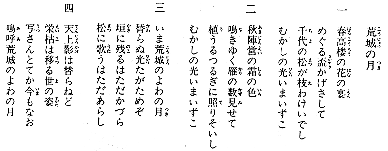
荒城の月

春高楼の花の宴
めぐる盃 影さして
千代の松ヶ枝わけいでし
むかしの光今何処

秋陣営の霜の色
鳴きゆく雁の数みせて
植うるつるぎに照りそひし
昔のひかりいまいづこ

今荒城の夜半の月
変らぬ光誰がためぞ
垣に残るは唯かづら
松に歌ふはたゞ嵐

天上影はかはらねど
栄枯は移る世の姿
うつさんとてか今もなほ
ああ荒城の夜半の月

*****
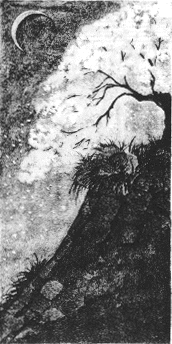
Many thanks to the Japan Information and Culture Center, a part of the Embassy of Japan, for contributing this song, the English translation, the illustration and the sheet music.

Many thanks to Susan Pomerantz for playing this tune on piano.

Thank you also to John Caughman for sending me the 2nd recording of this song. In John's recording, he sang the first verse in Japanese and then in English. You can visit John Caughman's site called Daygig Music to hear more of his songs!


http://www.mamalisa.com/images/misc/moonlightpic.gif


Japonais

Le clair de lune sur le château en ruines

Les fleurs de cerisiers s'ouvrent gracieusement au-dessus des champs,
Tout là-haut se dresse le mur du château,
Où sont partis les guerriers?
Où est le clair de lune qui brillait si vivement là-haut,
Brillait au-dessus des guerriers qui vidaient les verres?

Le givre blanc sur les champs d'automne gelant toute la nuit,
Des bandes d'oies sauvages crient
Et passent juste au-dessous de la lune.
Où est le clair de lune qui aurait pu briller si vivement,
Briller au-dessus des épées des guerriers, luisantes dans la nuit?

Oh, la lune se lève haut dans les profondeurs de la nuit,
Le site en ruines gît sur le sol en silence,
Le lierre grimpe sur la grille dans le froid clair de lune,
Les pins bruissent dans la nuit venteuse.

L'ascension et la chute, telle est la destinée des hommes,
La lune brille si haut,
Abaissant son regard vers le monde si loin au-dessous,
Que le clair de lune au-dessus du site en ruines est sublime,
Comme j'aime la lune qui brille sur dans les profondeurs de la nuit!.


Chanson traditionnelle

Translittération - Rōmaji (Romanji)
Kojo No Tsuki


Haru koro no hana no en
Meguru sakazuki kage sashite
Chiyo no matsu ga e wake ideshi
Mukashi no hikari Ima izu ko

Aki jinei no schimo no iro
Nakiyuku kari no kazu misete
Uurutsurugi ni terisoishi
Mukashi no hikari ima izu ko

Ima kojo no yowa no tsuki
Kawaranu hikari ta ga tame zo
Kaki ni nokoru wa tada kazura
Matsu ni uto wa tada arashi

Tenjo kage wa kawaranedo
Eiko wa utsuru yo no sugata
Utsusan toteka ima mo nao
Ah! Kojo no yowa no tsuki

*****

Voici les paroles au format texte (Veuillez nous excuser si ça ne s'affiche pas correctement sur votre écran):

荒城の月

春高楼の花の宴
めぐる盃 影さして
千代の松ヶ枝わけいでし
むかしの光今何処

秋陣営の霜の色
鳴きゆく雁の数みせて
植うるつるぎに照りそひし
昔のひかりいまいづこ

今荒城の夜半の月
変らぬ光誰がためぞ
垣に残るは唯かづら
松に歌ふはたゞ嵐

天上影はかはらねど
栄枯は移る世の姿
うつさんとてか今もなほ
ああ荒城の夜半の月


Sadao Mazuka m'a écrit en juin 2004, "Je vous envoie la chanson de Kojo No Tsuki, ou Clair de lune sur le château en ruines... J'ai 65 ans et j'étais ingénieur de NTT. Aussi, je suis un total amateur en matière de chant. Mon chant n'est pas fabuleux mais je serais heureux que ce soit un genre de référence pour votre site Web."

y

Merci beaucoup à l'Ambassade du Japon aux USA, pour cette chanson et l'illustration.

y

Merci beaucoup à Susan Pomerantz d'avoir joué l'air au piano.

Merci aussi à Sadao Mazuka de m'avoir envoyé l'enregistrement de cette chanson.


Japonés

Claro de luna sobre el Castillo ruinoso

Las flores de cerezos se abren graciosamente por encima de los campos,
Allí arriba se yergue la muralla el castillo,
¿A dónde se fueron los guerreros?
¿Dónde está el claro de luna que brillaba tan vivamente arriba,
Brillaba por encima de los guerreros que vaciaban los vasos?

La escarcha blanca sobre los campos del otoño, helando toda la noche,
Unas bandadas de ocas salvajes gritan
Y pasan justo más abajo de la luna.
¿Dónde está el claro de luna que hubiera podido brillar vivamente,
Brillar encima de las espadas de los guerreros, lucientes en la noche?

Ho, la luna se levanta alto el lo más profundo de la noche,
El sitio en ruinas yace sobre el suelo en silencio,
La hiedra sube por la verja, en el frío claro de luna,
Los pinos susurran la noche ventosa.

La ascensión y la caída, tal es el destino de los hombres,
La luna brilla tan alto,
Bajando su mirada hacia el mundo, tan lejos más abajo,
¡Cómo el claro de luna más arriba del sitio en ruinas es sublime!
¡Cuánto me gusta la luna que brilla en lo más profundo de la noche!


Canción infantil

Transliteración - Rōmaji (Romanji)
Kojo No Tsuki


Haru koro no hana no en
Meguru sakazuki kage sashite
Chiyo no matsu ga e wake ideshi
Mukashi no hikari Ima izu ko

Aki jinei no schimo no iro
Nakiyuku kari no kazu misete
Uurutsurugi ni terisoishi
Mukashi no hikari ima izu ko

Ima kojo no yowa no tsuki
Kawaranu hikari ta ga tame zo
Kaki ni nokoru wa tada kazura
Matsu ni uto wa tada arashi

Tenjo kage wa kawaranedo
Eiko wa utsuru yo no sugata
Utsusan toteka ima mo nao
Ah! Kojo no yowa no tsuki

*****

He aquí la letra en formato texto (Disculpen si no se visualiza correctamente en su pantalla):

荒城の月

春高楼の花の宴
めぐる盃 影さして
千代の松ヶ枝わけいでし
むかしの光今何処

秋陣営の霜の色
鳴きゆく雁の数みせて
植うるつるぎに照りそひし
昔のひかりいまいづこ

今荒城の夜半の月
変らぬ光誰がためぞ
垣に残るは唯かづら
松に歌ふはたゞ嵐

天上影はかはらねど
栄枯は移る世の姿
うつさんとてか今もなほ
ああ荒城の夜半の月


y

Muchas gracias a la Embajada de Japón en los EE UU por esta canción, la traducción inglesa, la partitura e la ilustración.

y


Muchas gracias a Pomerantz por tocar la música con el piano

Muchas gracias a Sadao Mazuka por mandarme una grabación de esta canción. Sadao Mazuka me escribió en junio de 2004: "Mando la canción de Kojo No Tsuki, o Claro de luna sobre el castillo ruinoso... Tengo 65 años y era un ingeniero de NTT. Luego soy un cantante aficionado total. No canto muy bien pero quedaré muy contento si puede ser una referencia para su Web." Apreciamos mucho su grabación que nos permite seguir la pronunciación de la transliteración mientras la vamos escuchando. ¡Gracias otra vez! Lisa.

Muchas gracias también a John Caughman por mandarme la 2a grabación de esta canción. En la grabación de John, canta la primera estrofa en japonés, después en inglés. ¡Pueden visitar la web de John Caughman llamada Daygig Music para escuchar más canciones suyas!


http://www.mamalisa.com/images/scores/mli1scor.jpg


http://www.mamalisa.com/world/moonligh.html

http://www.mamalisa.com/world/mligscor.html


http://www.mamalisa.com/images/misc/japshodo.gif

Asia


Japan

Japanese

http://www.mamalisa.com/world/japan.html

http://www.mamalisa.com/images/back_buttons/japanbut.gif

http://www.mamalisa.com/images/flags/japatiny.gif

http://www.mamalisa.com/images/flags/japansm.gif

http://www.mamalisa.com/images/flags/japaflag.gif

http://www.mamalisa.com/images/country_names/japaword.gif

http://www.mamalisa.com/images/country_images/japan.gif


http://www.mamalisa.com/images/misc/japshodo.gif

97


Japon


japonaises

du

http://www.mamalisa.com/fr/japon.html

http://www.mamalisa.com/fr-images/spacers and mlbuts/japonbout.gif

http://www.mamalisa.com/fr-images/mots/japonmot.gif

http://www.mamalisa.com/fr-images/pays/japon.gif


Japón

japonesas

http://www.mamalisa.com/sp/japon.html

http://www.mamalisa.com/sp-images/spacers and mlbuts/japobot.gif

http://www.mamalisa.com/sp-images/palabras/japoword.gif

http://www.mamalisa.com/sp-images/paises/japan.gif


Thank you also to Sadao Mazuka for sending me the 3rd recording of this song. Sadao Mazuka wrote me in June 2004, "I am sending the song of Kojo No Tsuki, or Moonlight on the Ruined Castle... I am 65 years old and was an engineer of NTT. So I am completely an amateur on singing. Not so good singing but it is my pleasure if it would be a kind of reference for your Web." - We do appreciate your recording as it lets us follow along with the transliteration to hear how to pronounce it. Thanks again! Lisa
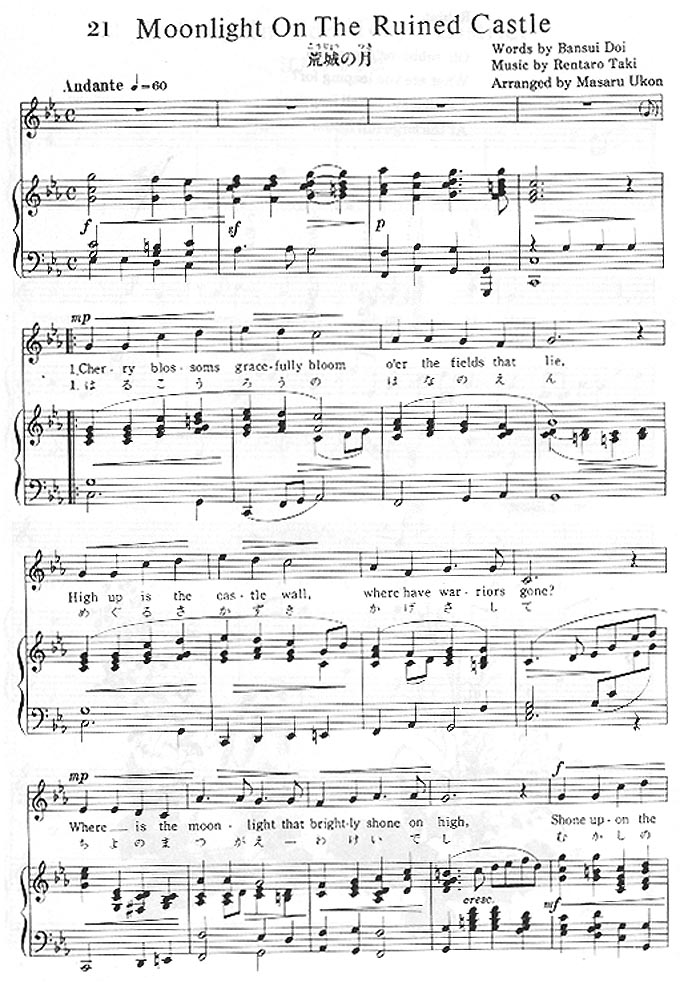
Thank you also to John Caughman for sending me the 2nd recording of this song. In John's recording, he sang the first verse in Japanese and then in English. You can visit John Caughman's site called Daygig Music to hear more of his songs!


Copyright ©2008 by Lisa Yannucci. All rights reserved.
Advertisements